
Triangle Calculator
3 values · at least one side · radian support (π/2, π/4 …)
Thank you for reading this post, don't forget to subscribe!Triangle Calculator
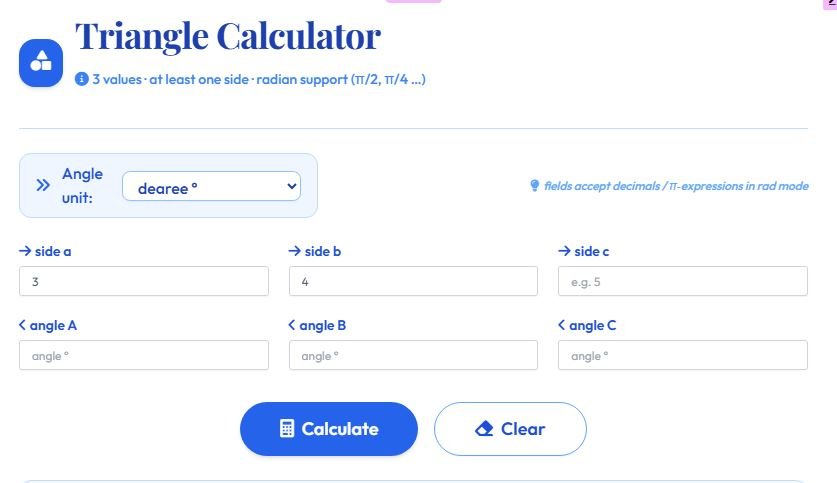
What Is a Triangle Calculator?
A triangle is a fundamental geometric shape classified as a polygon with three vertices and three sides. A vertex is a point where two line segments meet. In a triangle, each vertex is connected by straight line segments called edges, forming a closed shape.
Triangles are commonly named using their vertices. For example, a triangle with vertices A, B, and C is written as ΔABC. Triangles are mainly classified based on side lengths and interior angles, which makes them easier to analyze and calculate.
Types of Triangles Based on Sides
Triangles can be categorized according to the lengths of their sides:
Equilateral Triangle: All three sides are equal in length, and all interior angles are equal.
Isosceles Triangle: Two sides are equal in length, and the angles opposite those sides are also equal.
Scalene Triangle: All three sides and angles are different.
In diagrams, tick marks are often used to show equal side lengths, while arc marks indicate equal angles. These visual indicators help identify triangle properties quickly.
Relationship Between Sides and Angles
The sides and angles of a triangle are directly related. For example, an equilateral triangle has three equal sides and three equal angles. In calculator tools, triangle illustrations may not always appear to scale. The actual shape is determined only after numerical values are entered.
Types of Triangles Based on Angles
Triangles can also be classified by their internal angles:
Right Triangle: Contains one angle equal to 90°. The longest side, opposite the right angle, is called the hypotenuse.
Acute Triangle: All three angles are less than 90°.
Obtuse Triangle: One angle is greater than 90°.
Any triangle that is not a right triangle is known as an oblique triangle.
Important Triangle Rules and Properties
A triangle cannot have more than one angle greater than or equal to 90°.
The sum of interior angles of any triangle is always 180°.
An exterior angle equals the sum of the two non-adjacent interior angles.
The sum of the lengths of any two sides must be greater than the length of the third side.
Pythagorean Theorem (Right Triangles)
The Pythagorean theorem applies only to right triangles. It states that:
a² + b² = c²
Where c is the hypotenuse, and a and b are the other two sides.
Example:
If a = 3 and c = 5
b² = 25 − 9 = 16
b = 4
Special right triangles include 30°-60°-90°, 45°-45°-90°, and 3-4-5 triangles.
Law of Sines
The law of sines relates the sides of a triangle to the sine of their opposite angles:
a / sin(A) = b / sin(B) = c / sin(C)
This formula helps find unknown sides or angles when enough information is available. In some cases, two different triangle solutions may exist for the same input values.
Finding Angles Using Side Lengths
When all three sides are known, angles can be calculated using inverse cosine formulas:
A = arccos((b² + c² − a²) / 2bc)
B = arccos((a² + c² − b²) / 2ac)
C = arccos((a² + b² − c²) / 2ab)
Area of a Triangle
There are multiple ways to calculate the area of a triangle, depending on available data.
1. Base and Height Formula
Area = ½ × base × height
2. Two Sides and Included Angle
Area = ½ × ab × sin(C)
3. Heron’s Formula
Used when all three sides are known:
s = (a + b + c) / 2
Area = √[s(s − a)(s − b)(s − c)]
Median of a Triangle
A median is a line segment from a vertex to the midpoint of the opposite side. Every triangle has three medians, and they intersect at a point called the centroid, which represents the triangle’s balance point.
Inradius of a Triangle
The inradius is the radius of the largest circle that fits inside a triangle. It is calculated using:
Inradius = Area / s
Where s is the semi-perimeter of the triangle. The center of this circle is called the incenter, and it is equally distant from all sides.
Circumradius of a Triangle
The circumradius is the radius of a circle that passes through all three vertices of a triangle. The center of this circle is known as the circumcenter, which may lie inside or outside the triangle.
Circumradius = a / (2 × sin(A))
Any side and its opposite angle can be used in this formula.
o.